- TV Video Cables & Interconnects Items
- sku: 10366733755889611
- INLINE DAG152
DAG152 INLINE Rgbhv Distribution Amplifier Analog Video
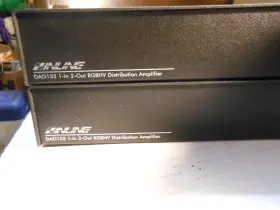
| Brand | INLINE |
|---|---|
| Manufacturer Part Number | DAG152 |
| Type | VIDEAO INTERFACE |
Review INLINE 1-in Rgbhv Distribution Amplifier Analog Video
The inline DAG-152 1-in 2-out RGBCHV distribution amplifier is a versatile and high-performance video component designed to amplify and distribute analog RGBCHV (Red, Green, Blue, Common Horizontal, and Common Vertical) signals. This amplifier is an essential tool for broadcasters, video installers, and AV professionals who need to transmit and distribute high-quality video signals over long distances or to multiple displays.
The 1-in 2-out design of the DAG-152 allows you to input one RGBCHV video signal and output two identical signals, making it perfect for applications that require redundancy or the distribution of video signals to multiple displays. The amplifier's RGBCHV input and outputs support a wide range of video formats, including SD and HD resolutions, making it suitable for various applications.
The DAG-152 is built with high-quality components that ensure the amplification and distribution of video signals with minimal signal loss, distortion, and interference. It features an automatic gain control (AGC) function that adjusts the input gain level to maintain optimal signal levels, ensuring consistent and reliable video quality. The amplifier also has a built-in DC power supply, allowing it to be powered directly from the video source or an external power source.
The DAG-152 is designed with a rugged and compact housing, making it suitable for use in harsh environments and installation in tight spaces. It also features a user-friendly front panel with status indicators for input and output signals, making it easy to monitor and troubleshoot any issues. The amplifier is also RoHS compliant and meets the EN 55013 and EN 55022 EMC standards, ensuring that it operates smoothly in various environments.
In summary, the inline DAG-152 1-in 2-out RGBCHV distribution amplifier is a high-performance and versatile video component designed for the amplification and distribution of analog RGBCHV video signals. Its 1-in 2-out design, automatic gain control function, and rugged construction make it an ideal solution for various applications in broadcasting, video installation, and AV professional settings.
A RGHV (Red, Green, Blue-Horizontal, Vertical) inline distribution amplifier with a 1-in-2-out configuration is a device used to amplify and distribute analog video signals. Here are some pros and cons of buying this type of amplifier:
Pros:1. Signal Amplification: The primary function of a distribution amplifier is to amplify the incoming video signal to ensure that it maintains its quality as it is distributed to multiple devices or displays.
2. Signal Splitting: A 1-in-2-out configuration allows the amplifier to split the incoming signal into two output signals, enabling the distribution of video to two separate devices or displays.
3. Improved Picture Quality: A well-designed distribution amplifier can help improve picture quality by reducing signal degradation, such as picture "snow" or "hiss," that can occur during long cable runs.
4. Easy Installation: Inline distribution amplifiers are designed to be easily installed in the middle of a cable run, making them a convenient solution for distributing video signals in larger installations.
Cons:1. Cost: Distribution amplifiers can be more expensive than simple signal splitters or amplifiers.
2. Complexity: Inline distribution amplifiers can be more complex than other types of video distribution solutions, requiring more careful installation and configuration.
3. Potential for Signal Degradation: If not properly designed or installed, distribution amplifiers can introduce additional signal degradation, such as increased noise or distortion.
4. Analog Signal Limitation: Distribution amplifiers are designed for analog video signals and may not be compatible with digital signals.
In conclusion, an inline RGHV distribution amplifier with a 1-in-2-out configuration can be a useful tool for amplifying and distributing analog video signals to multiple devices or displays. However, it comes with some potential drawbacks, such as cost, complexity, and potential signal degradation. If you are confident in your installation abilities and require a reliable solution for distributing analog video signals, then a distribution amplifier may be the best choice. However, if you are looking for a simpler and more cost-effective solution, consider other options like signal splitters or amplifiers.
Details:
Also have one with no transformer box does not space for it in21 weight 2 .25 lbs this uses the twist lock 5 wire cables in and x out. Good luck on buying/ buying.
specifications vcinterconnects:
- brand: Inline
- mpn: Dag152
- type: Videao Interface
seller vcinterconnects:
- rating: 99.5%
- city: edwardsville, illinois
- # reviews: 3859
returns vcinterconnects:
- policy: returns accepted
- paid by: seller
- method: money back
- time: 30 days
shipping vcinterconnects:
- service: standard
- type: fixed
- transit: 4-6 days
- class: standard
general vcinterconnects:
- category: Electronics > Tv, Audio > Accessories > Video Cables Interconnects
payments vcinterconnects:
- wallet: apple-pay
- credit card: mastercard
- other
offer vcinterconnects:
- options: ship-to-home
- in stock #: 2
- prices: $65.00–$70.00
- item condition:
- Open box
- New – Open box
- best offers: true
- started: january 17, 2026
- sold #: 9
- availability: in stock
